Pearson Edexcel · A-Level · Mathematics
Course version: 9MA0 · Version from Mar 2026
Work with quadratic functions and their graphs. The discriminant of a…
Full specification wording
Algebra and functions: 2.3 Work with quadratic functions and their graphs. The discriminant of a quadratic function, including the conditions for real and repeated roots. Completing the square. Solution of quadratic equations including solving quadratic equations in a function of the unknown.
A quadratic f(x) = ax² + bx + c has a parabolic graph; its shape and position follow from a, b and c, with the vertex found by completing the square.
Checked against the Pearson Edexcel 9MA0 specification (opens in a new tab) on .
- Point 3 of 11
- 4 key terms
Study notes
From the checked teaching notes for this specification point.
The idea
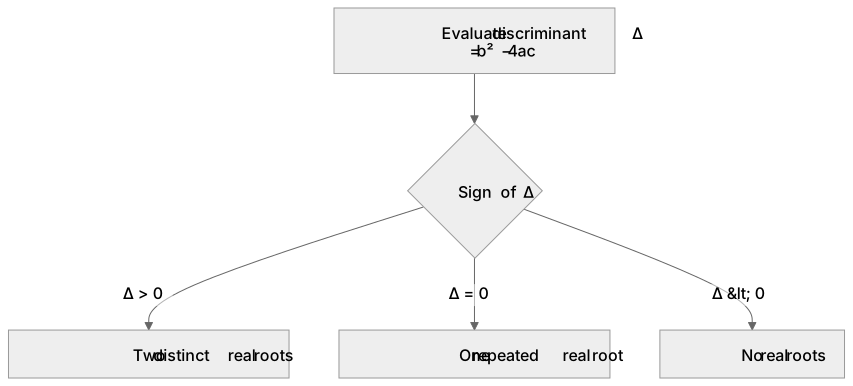
A quadratic f(x) = ax² + bx + c has a parabolic graph; its shape and position follow from a, b and c, with the vertex found by completing the square. Writing ax² + bx + c as a(x + p)² + q gives the minimum or maximum value q at x = −p, and the line of symmetry x = −p. The discriminant Δ = b² − 4ac decides the roots: Δ > 0 gives two distinct real roots, Δ = 0 gives a repeated real root, and Δ < 0 gives no real roots. Solving equations may need factorising, the formula or completing the square. Equations in a function of the unknown, such as x⁴ − 5x² + 4 = 0, are solved by substituting u = x², solving the quadratic in u, then converting back and checking each value.
What earns the marks
- Completes the square correctly, for example x² + 6x + 1 = (x + 3)² − 8, and reads off the vertex (−3, −8) and the minimum value −8.
- Evaluates the discriminant b² − 4ac and interprets its sign: two distinct real roots when positive, one repeated real root when zero, no real roots when negative.
- Solves a quadratic by an efficient method, factorising where possible, otherwise the formula or completing the square, and states both roots.
- Solves an equation in a function of the unknown by substituting a single letter for that function, solving the resulting quadratic, then reversing the substitution and rejecting values that the function cannot take.
- Links the graph to the algebra, identifying intercepts, the vertex and the line of symmetry from the completed-square form.
Common mistakes and how to put them right
Sign errors when completing the square, such as writing (x + 3)² + 8 instead of (x + 3)² − 8.
Put it right by expanding the bracket mentally to check the constant term.
Treating a negative discriminant as meaning the equation has no solution at all.
Put it right by saying there are no real roots, since complex roots are not required here.
Forgetting to reverse the substitution after solving in u, or accepting every value of u.
Put it right by converting each u back and discarding values the original function cannot produce, such as a negative value of x².
Exam tips
- Show the substitution and the reversed substitution explicitly when solving an equation in a function of the unknown, so the method is visible.
- When a question says 'hence' after completing the square, use the completed-square form rather than restarting with the formula.
- Sketch the parabola with its vertex and intercepts to support written conclusions about roots and inequalities.
Try the lesson
The start of the Algebra and functions: 2.3 Work with quadratic functions and their graphs. The discriminant of a quadratic function, including the conditions for real and repeated roots. Completing the square. Solution of quadratic equations including solving quadratic equations in a function of the unknown. lesson, made from checked teaching notes for this specification point.
Have a go first
The quadratic equation 2x^2 - 8x + p = 0 has exactly one real repeated root. What is the value of p?
Listen
A quadratic f(x) = ax² + bx + c has a parabolic graph; its shape and position follow from a, b and c, with the vertex found by completing the square. Writing ax² + bx + c as a(x + p)² + q gives the minimum or maximum value q at x = −p, and the line of symmetry x = −p. The discriminant Δ = b² − 4ac decides the roots: Δ > 0 gives two distinct real roots, Δ = 0 gives a repeated real root, and Δ < 0 gives no real roots. Solving equations may need factorising, the formula or completing the square. Equations in a function of the unknown, such as x⁴ − 5x² + 4 = 0, are solved by substituting u = x², solving the quadratic in u, then converting back and checking each value. A strong answer earns marks for these points. Completes the square correctly, for example x² + 6x + 1 = (x + 3)² − 8, and reads off the vertex (−3, −8) and the minimum value −8. Evaluates the discriminant b² − 4ac and interprets its sign: two distinct real roots when positive, one repeated real root when zero, no real roots when negative. Solves a quadratic by an efficient method, factorising where possible, otherwise the formula or completing the square, and states both roots. Solves an equation in a function of the unknown by substituting a single letter for that function, solving the resulting quadratic, then reversing the substitution and rejecting values that the function cannot take. A common slip: Sign errors when completing the square, such as writing (x + 3)² + 8 instead of (x + 3)² − 8. Instead, expanding the bracket mentally to check the constant term. Exam tip: Show the substitution and the reversed substitution explicitly when solving an equation in a function of the unknown, so the method is visible.
See it
Key words
Say what each word means before you turn the card.
Discriminant
Try answering aloud or in your head before turning the card.
Completing the square
Try answering aloud or in your head before turning the card.
Repeated real root
Try answering aloud or in your head before turning the card.
Equation in a function of the unknown
Try answering aloud or in your head before turning the card.
See every definition
- Discriminant
- The value b² − 4ac of a quadratic function, whose sign decides whether the roots are two distinct real roots, a repeated real root or no real roots.
- Completing the square
- Writing ax² + bx + c as a(x + p)² + q, which gives the minimum or maximum value q at x = −p and the line of symmetry x = −p.
- Repeated real root
- The single root that arises when the discriminant equals zero.
- Equation in a function of the unknown
- An equation such as x⁴ − 5x² + 4 = 0, solved by substituting a single letter for that function, solving the resulting quadratic, then reversing the substitution and checking each value.
There is more to this lesson
The full lesson goes on to check your understanding and help you earn the marks. Create a free account to carry on, with your progress saved.
A week of Premium from your first lesson · Then the free plan continues · No card, no charge
Test your understanding of Algebra and functions: 2.3 Work with quadratic functions and their graphs. The discriminant of a quadratic function, including the conditions for real and repeated roots. Completing the square. Solution of quadratic equations including solving quadratic equations in a function of the unknown.
Active recall beats re-reading. Take an instant quiz now to test what you’ve learned and lock it into long-term memory.
A week of Premium from your first lesson · Then the free plan continues · No card, no charge